
Love is said to move mountains. In myth, it moves the heavens.
Across civilizations—from ancient Greece to the temples of India, from the Nile to the underworld rivers of Mesopotamia—divine romances have shaped creation, triggered wars, and redrawn the stars. These stories are not merely fantastical dramas; they are mirrors. They reflect the same passions, jealousies, loyalties, and betrayals that define the human heart.
In this exploration of mythic love stories, we uncover how divine relationships reshaped the cosmos—and why their emotional truths still resonate today.

The Jealous Queen and the Thunderer: Hera and Zeus
Few mythic marriages are as turbulent as that of Hera and Zeus in Greek mythology.
Zeus, the king of the Olympians, ruled the skies with thunderbolts in hand, but his desires were as limitless as the skies he ruled. Though married to Hera, goddess of marriage and queen of the gods, Zeus pursued countless lovers: goddesses, nymphs, and mortal women alike.
Hera’s response was not passive sorrow. It was divine fury.
She punished Zeus’ lovers—transforming the priestess Io into a cow, driving Semele to her death, and tormenting Heracles, Zeus’ illegitimate son. Through Hera’s vengeance, we see the mythic amplification of betrayal’s emotional toll. Jealousy becomes cosmic. Hurt becomes storm.
Yet their marriage endured.
Why? Their union held significance beyond mere romance. It represented the balance of masculine and feminine authority, of sky and sovereignty, of law and chaos. Their strife was not simply marital—it was elemental.
Human Reflection:
The Hera–Zeus dynamic mirrors the painful paradox of love entangled with power. It shows how betrayal fractures trust, yet also how relationships can persist amid deep imperfection.

Love, Death, and the Seasons: Persephone and Hades
In one of mythology’s most haunting romances, Persephone—the radiant daughter of Demeter—was abducted by Hades, lord of the underworld.
At first glance, this is no love story. It is a tale of force and grief.
Demeter’s sorrow at her daughter’s disappearance plunged the earth into famine. Crops withered. Humanity starved. Only when a compromise was reached—Persephone would spend part of the year above ground and part below—did the world find balance again.
Thus the seasons were born.
Yet later interpretations suggest something more complex. In some tellings, Persephone grows into her role as queen of the underworld, transforming from captive maiden to sovereign power. Her bond with Hades becomes less about abduction and more about shared dominion over death’s mysteries.
Human Reflection:
This myth speaks to transformation through trauma, to the way love can evolve in unexpected terrain. It reflects the tension between loss and growth and the painful reality that love sometimes demands sacrifice.
The Star-Crossed Lovers of Egypt: Isis and Osiris
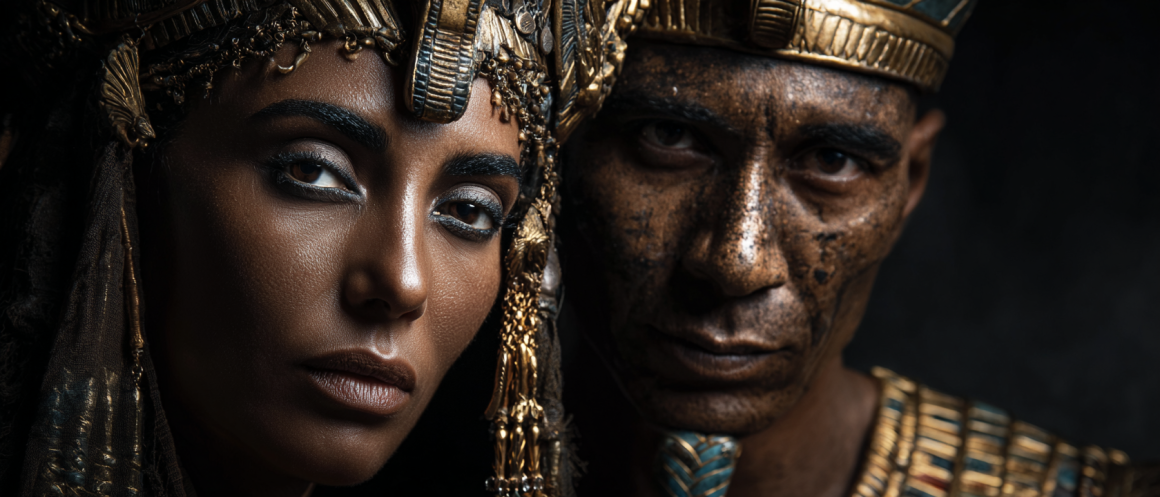
In ancient Egypt, love conquered death itself.
His jealous brother Set murdered and dismembered Osiris, the divine king and bringer of civilization. His body was scattered across the land.
But Isis, his devoted wife and sister, refused to surrender to despair.
She searched tirelessly for the pieces of Osiris, reassembled him through magic, and briefly restored him to life long enough to conceive their son, Horus. Osiris would become ruler of the afterlife; Horus would avenge him.
Isis’ love was not possessive or wrathful—it was restorative. Creative. Unyielding.
Her devotion did not prevent tragedy, but it transformed it into continuity. Death became a gateway rather than an end.
Human Reflection:
Isis and Osiris embody enduring love through grief. Their story resonates with anyone who has loved beyond loss, who has carried memory like sacred fragments and rebuilt meaning from ruin.

Desire and Destruction: Shiva and Sati
In Hindu mythology, love’s betrayal shakes the cosmos.
Sati, daughter of King Daksha, loved Shiva—the wild ascetic god who meditated in cremation grounds and wore serpents as ornaments. Daksha despised Shiva’s unconventional nature and refused to invite him to a grand sacrificial ritual.
Humiliated by her father’s scorn toward her husband, Sati immolated herself in grief and defiance.
When Shiva learned of her death, his sorrow became apocalyptic. He roamed the universe in madness, carrying Sati’s body. His dance of destruction—Tandava—threatened cosmic collapse.
Only when Vishnu dismembered Sati’s corpse, allowing her to be reborn as Parvati, was balance restored.
Human Reflection:
This story illustrates the destructive force of dishonor and broken respect within families. It also reveals love’s cyclical power—death and rebirth intertwined, grief transmuted into renewal.

Beauty That Launched a Thousand Ships: Aphrodite and Ares
Even the goddess of love was not immune to scandal.
Aphrodite, married to Hephaestus, conducted a passionate affair with Ares, god of war. Their union symbolized the volatile blend of desire and aggression. Hephaestus discovered their affair and trapped them in a golden net, exposing them to the gods.
Humiliation echoed through Olympus.
Yet their forbidden love persisted in myth, producing children like Eros and Harmonia—embodiments of desire and balance.
Human Reflection:
Here love is reckless and intoxicating. It shows how attraction can defy duty and how eros—the primal force of longing—often disregards social order.

The Mesopotamian Queen of Heaven: Inanna and Dumuzi
In Sumerian myth, Inanna, goddess of love and war, chose Dumuzi as her consort. Their union symbolized fertility and royal power.
But when Inanna descended into the underworld and returned, she sought someone to take her place. Finding Dumuzi seated comfortably on her throne rather than mourning her absence, she condemned him to the underworld.
Later, moved by grief, she arranged for his partial return—thus establishing seasonal cycles.
Human Reflection:
This tale explores pride, abandonment, and regret. Love becomes intertwined with status and expectation. When devotion fails, consequences follow. Yet reconciliation remains possible.
Why Divine Love Stories Endure
Across cultures, divine romances share striking themes:
- Jealousy that reshapes worlds
- Devotion that conquers death
- Betrayal that births seasons
- Sacrifice that restores balance
Why do these stories endure?
The reason these stories endure is because the gods behave in a manner similar to our own, albeit magnified. Their loves are grander, their betrayals catastrophic, but their emotions are intimately human.
Ancient peoples projected their fears and desires onto the heavens. In doing so, they crafted narratives that explain natural cycles—storms, harvests, droughts, rebirth—not as random events, but as the emotional aftermath of divine relationships.
When Demeter grieves, winter falls.
When Shiva mourns, universes tremble.
When Isis loves, death yields.
The cosmos becomes emotional geography.
Love as Cosmic Law
In myth, love is not merely romance—it is a structuring principle of reality.
- Creation myths often begin with divine unions.
- Agricultural cycles mirror marital harmony or discord.
- Political legitimacy flows from sacred marriages between gods.
Divine love stories function as metaphors for order and chaos. When harmony exists between gods, the world flourishes. When betrayal fractures trust, droughts, wars, and disasters follow.
In this way, myth teaches that relationships—whether divine or human—are foundational to stability.
The Eternal Mirror
These stories persist because we recognize ourselves in them, not because we believe Zeus still hurls thunderbolts or that Isis wanders the Nile searching for fragments. They persist because we recognize ourselves in them.
We know jealousy.
We know longing.
We know heartbreak.
We know devotion that outlives death.
The gods loved as we do—intensely, imperfectly, destructively, beautifully.
And perhaps that is the deepest myth of all: that heaven itself is shaped by the same fragile, fierce force that governs the human heart.
Final Thoughts
“Love and Betrayal Among the Gods” reminds us that mythology is not distant fantasy. It is emotional truth wrapped in cosmic imagery. Through Hera’s rage, Persephone’s transformation, Isis’ devotion, Shiva’s grief, Aphrodite’s desire, and Inanna’s pride, we see that passion can destroy worlds—or create them anew.
The heavens changed because the gods loved.
And in every human love story, the universe changes again.